Eczema in children: what parents need to know
What is eczema in children?
Eczema (atopic dermatitis) is a chronic inflammatory skin disease that most often begins in early childhood. Statistics show that up to 20% of children worldwide have this condition; in 60% of cases the first signs appear before the age of one, and in 85% before the age of five. The disease has a genetic basis: if both parents are atopic, a child's risk of developing eczema reaches 80%. The underlying mechanisms are an impaired skin barrier (a deficiency of the protein filaggrin) and immune dysregulation.
Atopic and other forms of eczema in children
Several forms of eczema occur in childhood. Understanding the differences between them helps in choosing the right approach to treatment:
- atopic dermatitis: the most common form (up to 90% of all childhood eczema). In infants it affects the face, the scalp and the extensor surfaces of the limbs. In children over 2 it affects the flexures (the elbow and knee creases).
- contact dermatitis: caused by contact with irritants — synthetic fabrics, detergents, nickel in fastenings. In children it is often located where nappies, clothing or jewellery sit, and it can mimic the atopic form.
- seborrhoeic dermatitis: typical of infants in the first months of life — yellowish scales on the scalp (so-called cradle cap), behind the ears and in the folds. It usually resolves on its own by 6–12 months and is not accompanied by itching.
- triggers of flares: abrupt changes in temperature, dry air, stress, sweating, contact with wool and synthetics, food allergens (cow's milk, eggs, nuts, wheat), house dust, animal dander and pollen.
Clinical presentation and symptoms
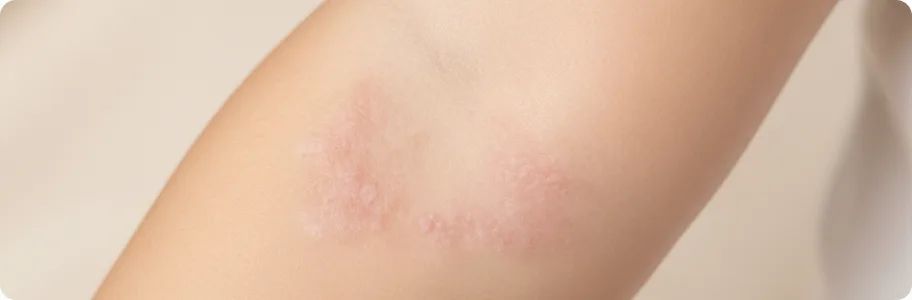
In infants, eczema usually starts with redness and weeping on the cheeks, forehead and chin, gradually spreading to the trunk and limbs. In children over 2 the typical location is the flexures, with lichenification (thickening of the skin). The main symptom is intense itching, which worsens at night and disturbs sleep. Scratching creates a vicious circle: itch → scratching → damaged skin → inflammation → more itching. The skin becomes dry and rough, and fissures and secondary infection (impetiginisation) may develop.
Diagnosis
Atopic dermatitis is diagnosed clinically using the Hanifin–Rajka criteria. The mandatory ones are itching, typical morphology and distribution of the rash, a chronic relapsing course, and atopy in the personal or family history. Additional ones are dry skin (xerosis), a raised IgE level, early onset and a tendency to skin infections. Allergy testing (skin prick tests, specific IgE) is done to identify trigger allergens, not to make the diagnosis. The differential diagnosis includes seborrhoeic dermatitis, psoriasis, scabies and rare immunodeficiencies (Wiskott–Aldrich syndrome).
Treatment and daily care
The basis of treatment is regular moisturising with emollients (at least 2–3 times a day, using 250–500 g per week). Bathing should be short (5–10 minutes) in warm water without soap, with an emollient applied within 3 minutes of the bath. Topical corticosteroids (1% hydrocortisone for the face, mometasone for the body) are used during flares in courses of 7–14 days. Calcineurin inhibitors (tacrolimus 0.03% for children from the age of 2) are used as steroid-sparing therapy. A proactive regimen (applying a topical corticosteroid twice a week to areas of previous flares) reduces the relapse rate by 50%. Antihistamines have no effect on the itch of eczema.
When to see a doctor
See a paediatrician or dermatologist immediately if signs of infection appear on the child's skin (purulent crusts, blisters with cloudy contents, weeping with an unpleasant smell), if the eczema is spreading despite treatment, if the child has been sleeping badly because of itching for more than 2 weeks, or if there are signs of eczema herpeticum (the sudden appearance of painful clustered blisters with a high temperature) — a condition that requires urgent care.
Related reading
Did not find the answer to your question?
Every case is individual. If you have noticed changes in your skin, or have symptoms that concern you, book a consultation.