Scalp psoriasis: how it differs from dermatitis

What is scalp psoriasis?
Scalp psoriasis is a chronic autoimmune disease in which an accelerated cycle of skin cell renewal leads to the formation of thick silvery-white scales and reddened areas. Unlike ordinary flaking, psoriatic plaques are sharply demarcated, adhere firmly to the skin and may extend beyond the hairline — onto the forehead, behind the ears and onto the back of the neck. The disease follows a fluctuating course with periods of flare and remission. Psoriasis is not contagious and is not passed on by contact, but it has a substantial effect on the patient's quality of life.
Key differences from seborrhoeic dermatitis
Psoriasis and seborrhoeic dermatitis often affect the same area — the scalp — and so are easily confused. The main differences:
- the nature of the scales: in psoriasis the scales are thick, silvery-white, dry and firmly bound to the plaque. In dermatitis they are thin, yellowish, greasy and easily lifted. Removing psoriatic scales can cause pinpoint bleeding (the Auspitz sign).
- the borders of the lesions: psoriatic plaques have sharp, clearly defined edges. Seborrhoeic dermatitis has blurred, indistinct borders where the redness fades gradually into healthy skin.
- distribution: psoriasis often extends beyond the hairline onto the forehead, the temples and behind the ears. Dermatitis is usually confined to the scalp, the folds behind the ears and the nasolabial folds.
- itching and associated symptoms: in dermatitis the itch is moderate and is often accompanied by oily skin. In psoriasis the itch can be intense, the skin is dry and tight, and hair may be lost over the plaques because of the constant inflammation.
Diagnosis: telling psoriasis from dermatitis
The differential diagnosis rests on clinical examination, dermatoscopy and, where necessary, a skin biopsy. On dermatoscopy, psoriasis shows characteristic features: evenly distributed dotted vessels (a "red dots pattern"), diffuse white scales and an absence of yellow structures. Seborrhoeic dermatitis, by contrast, shows yellowish scales, atypical red vessels and structureless orange-yellow areas. Laboratory tests include an IgE level (raised in dermatitis), a full blood count and, if needed, mycological testing to exclude a fungal infection.
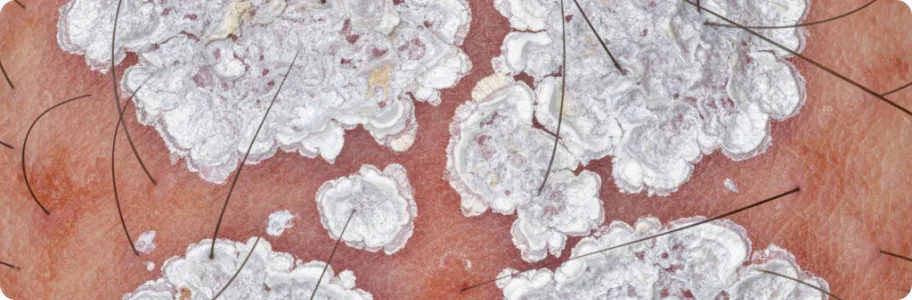
What dermatoscopy shows in psoriasis
Dermatoscopy is the key tool for diagnosing scalp psoriasis. At 20–200 times magnification the doctor assesses the vascular pattern — psoriasis is characterised by evenly distributed dotted or glomerular vessels. The scales are assessed as well: in psoriasis they are white, dry and layered. Perifollicular inflammation and erythema around the follicular openings indicate active disease. To monitor the effectiveness of treatment, dermatoscopy is repeated every 4–8 weeks: a reduction in the number of dotted vessels and in the thickness of the scales indicates a good response.
Current approaches to treatment
Treatment of scalp psoriasis includes both topical and systemic therapy. The first line is topical corticosteroids in solutions, lotions and foams — they reduce inflammation and itching quickly. Calcipotriol (a vitamin D analogue) is used alone or in combination with corticosteroids for long-term control. Keratolytics with salicylic acid help to soften and remove the scales. In severe disease, systemic drugs are prescribed — methotrexate, ciclosporin or biologic agents (IL-17 and IL-23 inhibitors). Narrowband UVB phototherapy is also effective, although harder to apply to a hair-bearing area.
Advice on care
Good home care is an important addition to medical treatment. Use gentle sulphate-free shampoos with a neutral pH and avoid hot water and vigorous combing. Medicated shampoos with tar, ketoconazole or zinc pyrithione are used in courses on a doctor's advice. Moisturising the scalp with emollients after washing reduces dryness and flaking. Avoid triggers for flares: stress, alcohol, smoking, cold exposure and injury to the skin.
Related reading

Did not find the answer to your question?
Every case is individual. If you have noticed changes in your skin, or have symptoms that concern you, book a consultation.